Hiroshima is the capital of Hiroshima Prefecture and the largest city of the Chugoku Region, the westernmost region on Japan's main island of Honshu. It is home to about one million people.
On August 6, 1945, Hiroshima was chosen by US armed forces as the first ever target of an atomic bomb employed over a populated area. As a result, 200,000 civilians lost their lives, and Hiroshima became a city vehemently engaged in the promotion of peace.
Hiroshima's Peace Park including the memorial museum, and the island of Miyajima (literally: shrine island), located 40 minutes from the city center by train and ferry, are among Japan's most interesting tourist attractions
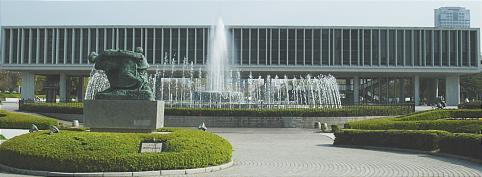
The Peace Memorial Museum graphically displays the atomic bomb's horrible effects on the city and its inhabitants. A visit is naturally depressing. In the museum's east building, Hiroshima's militarist past and the process leading to the dropping of the bomb are documented. Audio guides are available in more than a dozen languages.
The Atomic Bomb Dome is one of the few buildings around the explosion's epicenter that partially survived the blast, and the city's only remaining bomb damaged building. The former Industrial Promotion Hall is now an UNESCO World Heritage Site.

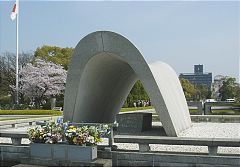
Between the museum and the Atomic Bomb Dome stands the Memorial Cenotaph for Atomic Bomb Victims. It contains a list of all the people who were killed by the explosion or died due to the bombing's long-term effects such as cancer caused by radiation. The Statue of the A-Bomb Children and the Cenotaph for Korean Victims are some of many more monuments found in the park.
_________________________________________________________________________________________
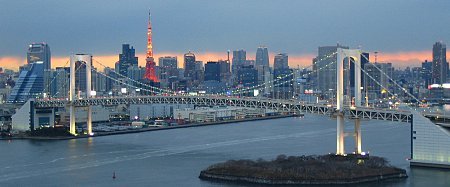
Tokyo is Japan's capital and the country's largest city.
Tokyo is also one of Japan's 47 prefectures, but is called a metropolis (to) rather than a prefecture (ken). The metropolis of Tokyo consists of 23 city wards (ku), 26 cities, 5 towns and 8 villages, including the Izu and Ogasawara Islands, several small Pacific Islands in the south of Japan's main island Honshu.
The 23 city wards (ku) are the center of Tokyo and make up about one third of the metropolis' area, while housing roughly eight of Tokyo's approximately twelve million residents.
Prior to 1868, Tokyo was known as Edo. A small castle town in the 16th century, Edo became Japan's political center in 1603 when Tokugawa Ieyasu established his feudal government there. A few decades later, Edo had grown into one of the world's most populous cities.
With the Meiji Restoration of 1868, the emperor and capital where moved from Kyoto to Edo, which was renamed Tokyo ("Eastern Capital"). Large parts of Tokyo were destroyed in the Great Kanto Earthquake of 1923 and in the air raids of 1945
In the year 710, the first permanent Japanese capital was established in Nara, a city modelled after the Chinese capital. Large Buddhist monasteries were built in the new capital. The monasteries quickly gained such strong political influence that, in order to protect the position of the emperor and central government, the capital was moved to Nagaoka in 784, and finally to Heian (Kyoto) in 794 where it should remain for over one thousand years.
One characteristic of the Nara and Heian periods is a gradual decline of Chinese influence which, nevertheless, remained strong. Many of the imported ideas were gradually "Japanized". In order to meet particular Japanese needs, several governmental offices were established in addition to the government system which was copied after the Chinese model, for example. In the arts too, native Japanese movements became increasingly popular. The development of the Kana syllables made the creation of actual Japanese literature possible. Several new Buddhist sects that were imported from China during the Heian period, were also "Japanized".
Among the worst failures of the Taika reforms were the land and taxation reforms: High taxes resulted in the impoverishment of many farmers who then had to sell their properties and became tenants of larger land owners. Furthermore, many aristocrats and the Buddhist monasteries succeeded in achieving tax immunity. As a result, the state income decreased, and over the centuries, the political power steadily shifted from the central government to the large independent land owners.
The Fujiwara family controlled the political scene of the Heian period over several centuries through strategic intermarriages with the imperial family and by occupying all the important political offices in Kyoto and the major provinces. The power of the clan reached its peak with Fujiwara Michinaga in the year 1016. After Michinaga, however, the ability of the Fujiwara leaders began to decline, and public order could not be maintained. Many land owners hired samurai for the protection of their properties. That is how the military class became more and more influential, especially in Eastern Japan.
The Fujiwara supremacy came to an end in 1068 when the new emperor Go-Sanjo was determined to rule the country by himself, and the Fujiwara failed to control him. In the year 1086 Go-Sanjo abdicated but continued to rule from behind the political stage. This new form of government was called Insei government. Insei emperors exerted political power from 1086 until 1156 when Taira Kiyomori became the new leader of Japan.
In the 12th century, two military families with aristocratic backgrounds gained much power: the Minamoto (or Genji) and Taira (or Heike) families. The Taira replaced many Fujiwara nobles in important offices while the Minamoto gained military experience by bringing parts of Northern Honshu under Japanese control in the Early Nine Years War (1050 - 1059) and the Later Three Years war (1083 - 1087).
After the Heiji Rising (1159), a struggle for power between the two families, Taira Kiyomori evolved as the leader of Japan and ruled the country from 1168 to 1178 through the emperor. The major threats with which he was confronted were not only the rivalling Minamoto but also the increasingly militant Buddhist monasteries which frequently led wars between each other and disturbed public order.
After Kiyomori's death, the Taira and Minamoto clans fought a deciding war for supremacy, the Gempei War, which lasted from 1180 to 1185. By the end of the war, the Minamoto were able to put an end to Taira supremacy, and Minamoto Yoritomo succeeded as the leader of Japan. After eliminating all of his potential and acute enemies, including close family members, he was appointed Shogun (highest military officer) and established a new government in his home city Kamakura.
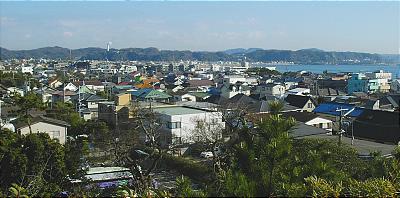
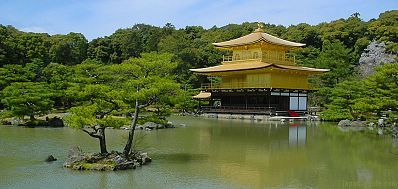
Kyoto was Japan's capital and the emperor's residence from 794 until 1868. It is now the country's seventh largest city with a population of 1.4 million people and a modern face.
Over the centuries, Kyoto was destroyed by many wars and fires, but due to its historic value, the city was not chosen as a target of air raids during World War II. Countless temples, shrines and other historically priceless structures survive in the city today.
_____________________________________________________________________________________
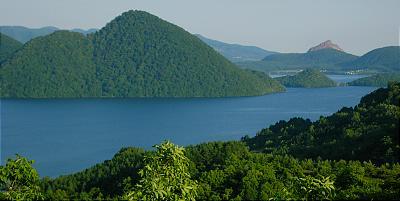
Lake Toya (Toyako) is part of the Shikotsu-Toya National Park. Besides the beautiful lake, the area offers hiking, fishing and camping opportunities, as well as hot springs and close up views of one of Japan's most active volcano's, Mount Usu (Usuzan), which most recently erupted in the year 2000
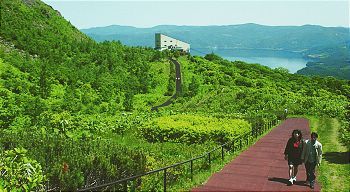
Mount Usu (Usuzan) is a volcano, which has erupted four times in the past 100 years, most recently in the year 2000.
The Usuzan Ropeway brings you close to the volcano's summit. The upper station's observation deck offers panoramic views of Lake Toya and neighboring Showa Shinzan. From a second observation deck, reached by a short walk, there are views of the ocean and Mount Usu's largest crater, dating from the 1977 eruption.
Operation hours: Daily, except in the second halves of December, January and February. Hours vary from 9:00-16:00 in winter to 8:15-17:45 in summer.
Round trip fare: 1,450 Yen
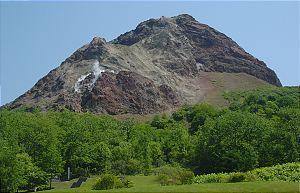
Showa Shinzan is one of Japan's youngest mountains.
Accompanied by earthquakes, the mountain suddenly rose from a flat wheat field to its current height of 290 meters between 1943 and 1945. According to the contemporary reign of Emperor Showa(1926-1989), the mountain was named "Showa New Mountain".
Still venting sulfurous fumes today, Showa Shinzan stands directly next to Mount Usu, which bears responsibility for the new mountain's birth. You can get good views of the young volcano by taking the Usuzan Ropeway.


